
Industry
Local Government – Arts, Culture & Creative Placemaking
Role
UX Researcher
Albert EL Fresco

Project Overview
Albert El Fresco is a public space designed for casual gathering, socializing, and passing through in a busy urban environment. The goal of this research project was to understand how people use the space, identify obstacles to smooth pedestrian flow, and gather insights to inform potential future design decisions around furniture layout and accessibility. I served as the sole UX researcher, conducting both ethnographic observations and a focus group over four weeks. Each visit lasted roughly one hour, with 3–4 visits per week, allowing me to observe the space at different times of day and week.
Research Goals
The research aimed to uncover how people use the space, including:
Where and how long people sit
Seating preferences and usage patterns
Pedestrian pathways and potential obstacles
Activities within the space
Perceptions of safety, comfort, and accessibility
This work was intended to inform future furniture layout decisions and overall spatial design, although I was not directly involved in implementing these changes.
Methods
Ethnographic Observation
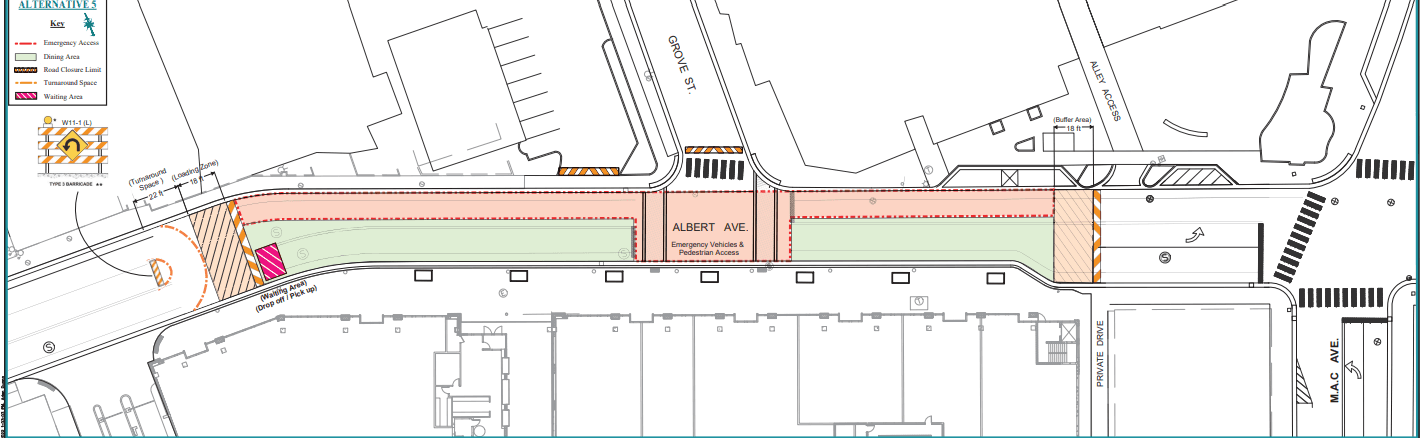
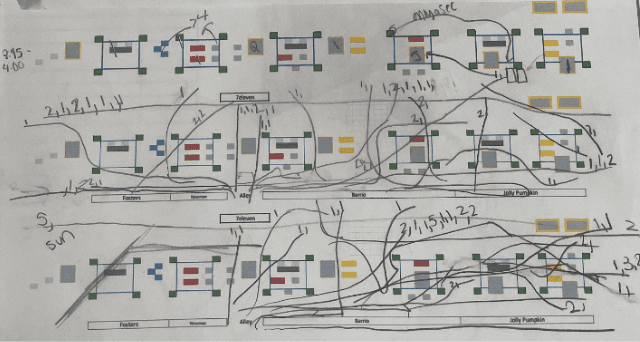
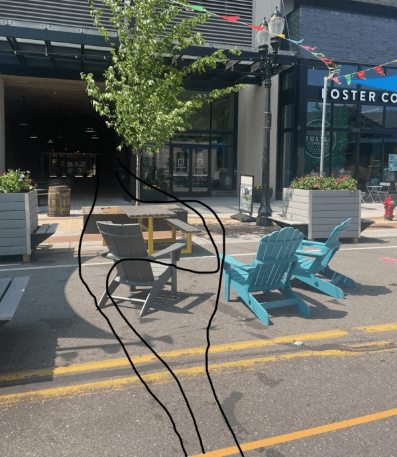
Before starting this research I photographed the space and digitally mapped all furniture, buildings and sidewalks. I then printed these layouts to track people’s seating choices, movement paths, and dwell times. Pencil annotations allowed me to quickly mark patterns while observing multiple groups simultaneously while I was observing.
Tracking was conducted in real-time, noting not just where people sat, but also group size, interactions, and behavior. Over multiple visits, I was able to compare usage patterns across different times of day, capturing both recurring behaviors and unique events.
Data Synthesis
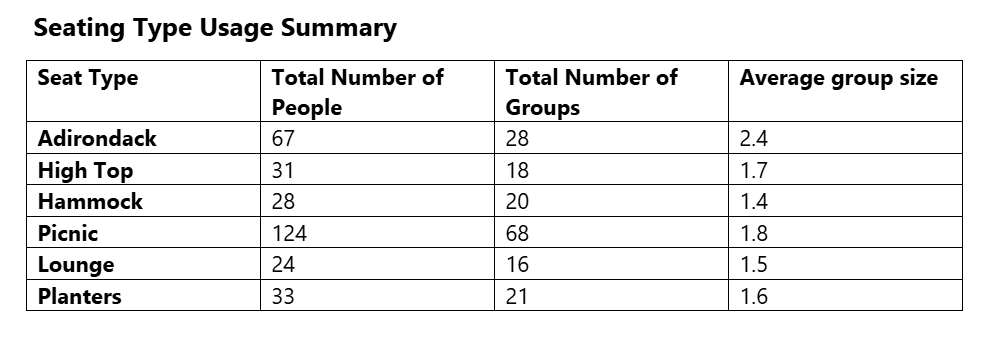
After each observation session, I aggregated quantitative data by counting the number of people per seating type, recording dwell times, and calculating group sizes. To understand pedestrian flow, I overlaid multiple observation sheets, revealing the most common routes through the space. This method allowed me to combine quantitative mapping with qualitative notes for a holistic view of the space.
Focus Groups
I also conducted a focus group with approximately ten participants to complement the ethnographic findings. The discussion explored participants’ perceptions of safety, cleanliness, seating preferences, and general use of the space. Focus group insights verified many patterns observed in the field, including preferred seating types, common activities, frustrations with construction and concerns about particular locals harassing the visitors of the space.
Key Findings
Seating Preferences
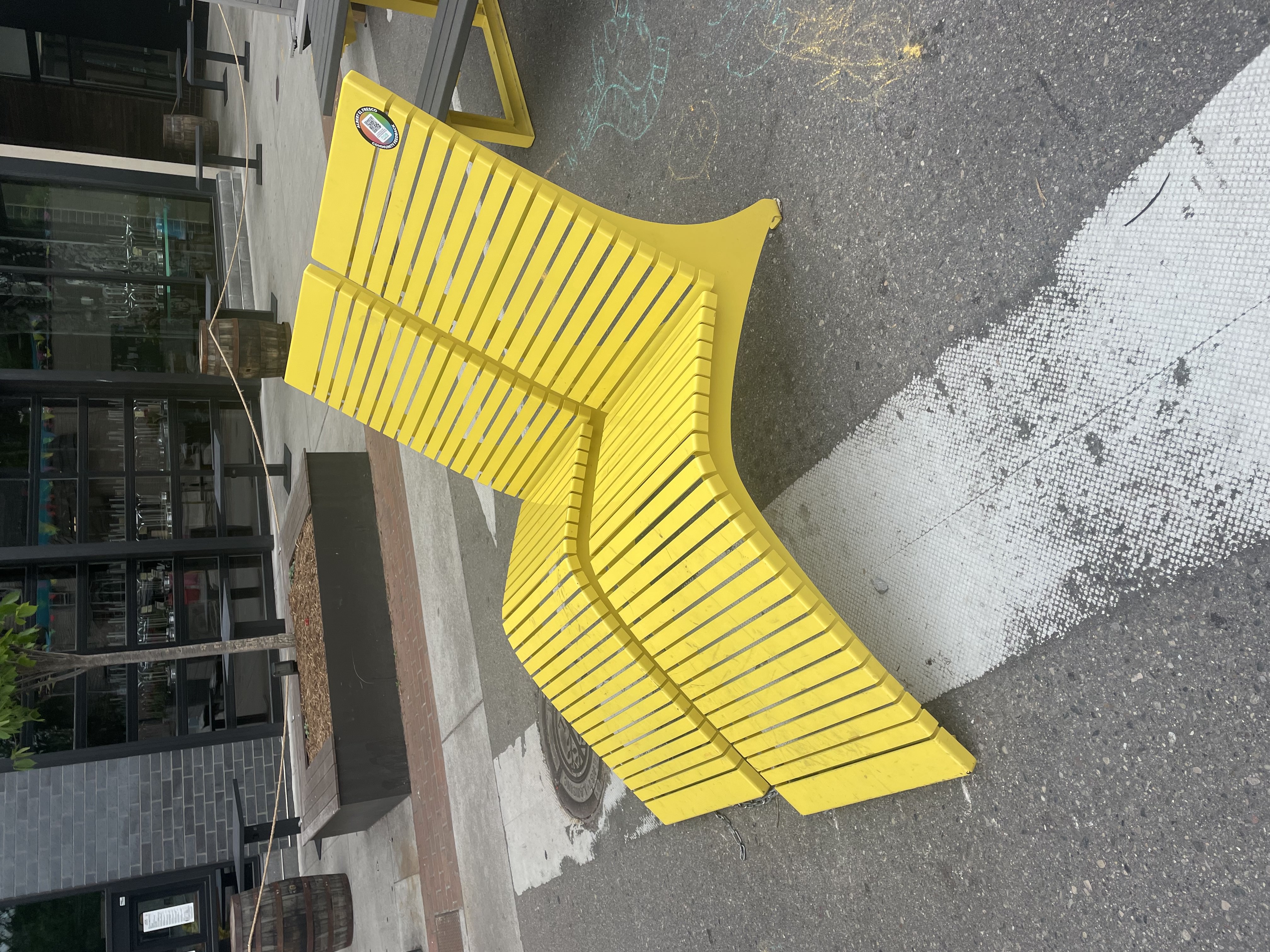
Seating preferences varied depending on group size and activity. Adirondack chairs were most popular with groups and supported longer stays. Picnic tables were versatile, accommodating both eating and socializing, while lounge chairs were often rearranged by families to accommodate everyone. Planters were primarily used for short visits or as temporary resting spots while waiting for others. Individual users tended to stay for shorter periods than groups, and children often engaged with the space through playful activities such as hopscotch, ping pong, or climbing on furniture.
Wayfinding and Pedestrian Flow
Furniture layout and restaurant expansions frequently obstructed natural pedestrian pathways. Users navigating through the space often had to take awkward routes, sometimes brushing past seated individuals or weaving around concrete barriers at high speeds on bicycles. This congestion disrupted both those lingering in the space and those passing through, illustrating a tension between comfort and flow. The ethnographic data revealed that even minor design frictions—like poorly positioned furniture—could significantly affect user experience.
Usage Patterns and Activities
Most users engaged in socializing, with talking being the predominant activity. Adults frequently used the space to work, eat, or meet friends, while children and teens engaged with playful elements such as taped hopscotch games or ping pong. Older adults preferred seating with backs or planter-integrated benches for shorter rests. Overall, the space supported a wide variety of activities, but usage patterns highlighted areas where the design could better accommodate both lingering and passing-through users.
Focus Group Insights
The focus group highlighted safety and cleanliness as top concerns. Participants enjoyed people-watching, meeting friends, and observing children’s activities. They also expressed frustrations with construction, crowded pathways, and uneven access to seating. These qualitative insights contextualized the observational findings and helped validate the patterns identified through the ethnography.
Reflection and Challenges
Conducting ethnographic observation in a dynamic public space proved to be a complex and demanding process. Note-taking had to be done entirely by hand, as I did not have access to better tools for real-time tracking or data synthesis. Initially, I attempted to record observations digitally, but working outdoors during the summer meant glare on screens made it difficult to see and enter data accurately. As a result, I relied on printed layouts of the space, using pencil to mark seating choices, paths, and dwell times across multiple sheets. Managing and organizing these sheets was itself a challenge, as I had to keep track of several overlapping observations while maintaining accuracy.
The complexity of the environment added additional difficulty. Multiple factors influenced behavior, including temperature, weather, events, and pedestrian interactions with furniture—sometimes people would move chairs or other pieces slightly, which made exact measurements challenging. Because of this, I focused on tracking broader patterns and recurring behaviors rather than exact numbers. While this approach required judgment calls and careful attention, it ultimately allowed me to identify meaningful trends in seating preferences, pedestrian flow, and interactions with the space that might have been missed if I had focused solely on quantitative data.
Impact and Recommendations
The study revealed important considerations for future design interventions. Furniture placement should account for pedestrian pathways and restaurant expansions to reduce congestion. Diverse seating types support multiple activities, but their distribution needs to balance group use with individual comfort. Observing real behavior in context reinforced the value of ethnographic research: small design frictions, if unaddressed, can create frustration and disrupt the overall user experience.
The study surfaced several design considerations for Albert EL Fresco, including the need for more intentional furniture placement, clearer pedestrian pathways, and a better balance between restaurant expansions and public use. While a variety of seating supported different activities, its distribution often contributed to congestion and friction between passersby, diners, and people trying to linger in the space. These findings echoed broader issues later reflected in public discussions: beginning in 2024, the footprint of Albert EL Fresco was reduced, influenced in part by business concerns about access and customer flow. However, families and some community groups expressed that they missed the larger, more spacious layout. Although I can’t confirm whether my research directly shaped those decisions, the outcome aligned with patterns identified in the study and underscored how public-space design is shaped not only by user behavior but by political and commercial pressures as well.
Visual Deliverables
The research included maps of pedestrian pathways, heatmaps of seating usage, photographs of furniture types, and aggregated tables summarizing dwell times, group sizes, and seat popularity. These deliverables helped communicate insights clearly and supported potential design decisions in the space.